
AI governance maturity is the degree to which an organization can trace, test, and control AI system behavior before it reaches production. It's not the existence of a policy document.
A mature enterprise AI governance framework treats every prompt, model call, and agent action as a versioned artifact. Each one is gated by evals and guardrails.
In February 2025, engineers started calling unstructured, prompt-driven coding "vibe coding."
According to AI Advances' 2025 retrospective on the vibe coding maturity spectrum, Karpathy coined the term that month. It went on to become Collins' Word of the Year. Karpathy himself retired it about a year later, replacing it with "agentic engineering." That shift is the entire vibe coding vs AI engineering debate, compressed into one naming decision.
This piece lays out an AI governance maturity model built from engineering practice. Four principles take you from ad-hoc prompt tinkering to AI engineering at scale: instrumented, evaluated, guarded, and auditable by default.
In this guide, you will learn:
- what an AI governance maturity model is,
- why most AI governance efforts stall before they reach production,
- the 4 stages of maturity, with the data on where organizations sit,
- how to score your own maturity level with a checklist for CTOs,
- the 4 engineering principles that move you up, with tracing, evals, and runtime guardrails,
- a practical framework you can apply this quarter.
Key insights
- Governance maturity is measured by engineering controls, what runs in your pipeline, not what sits in a document. Eight in ten organizations have a strategy on paper; almost none run it in production.
- An AI governance maturity model gives you two lenses: four stages that say where you are, and four principles that say how you climb.
- Most AI programs stall in the same place: governance policies written by risk management teams, enforced by nobody's pipeline.
- Adoption raced ahead of control: most organizations use AI, few govern it well, and documented incidents are rising.
What is AI governance maturity model?
An AI governance maturity model grades your AI program on one axis: how reliably you can trace, test, and control AI behavior before it reaches production. It reads two lenses at once.
The first is position – which of the four stages you sit in, from ungoverned vibe-coding to governed velocity.
The second is motion – the four engineering principles that move you between stages.
The stages tell you where you are; the principles are how you climb.
This is not a policy maturity model. A charter, an ethics board, and a high-risk AI systems register can all exist while nothing gates a single model call.
It spans three interdependent dimensions: the data your systems read, the process that ships them, and the people accountable for the outcome.
Governing the first of those, the knowledge agents read, is covered in Agentic Context Engineering: How to Govern the Knowledge Your AI Agents Read.
Maturity shows up in the pipeline – versioned prompts, evals on every change, guardrails at runtime, and an audit trail that writes itself.
This maturity model is one piece of the wider picture in AI Governance Solutions: The Complete Guide to Governed AI Engineering.
Why do most AI governance efforts stall?
Most AI initiatives fail for a structural reason: they're written by risk teams and enforced by nobody's pipeline.
The gap is not awareness. It is that the framework and the codebase never meet.
Policy written by risk, enforced by nobody's pipeline
The NIST AI Risk Management Framework organizes AI risk into four functions: Govern, Map, Measure, and Manage. Published in January 2023 and extended by a Generative AI Profile in July 2024, it's a solid map. But a map isn't a gate.
The OWASP GenAI Security Project's 2025 Top 10 lists prompt injection, sensitive information disclosure, and supply chain risk as the leading threats to LLM applications. All three require engineering controls, not committee sign-off.
Developers already voice this gap in public: orchestration and mature governance tooling for coding agents lag years behind the agents themselves.
That's AI development governance failing at the most basic level: no enforcement mechanism, just a document.
Initiatives without measurable maturity
According to Databricks' 2024 coverage of a Gartner survey, 80% of large organizations claim active AI governance initiatives.
Fewer than half can demonstrate measurable maturity, per the same Databricks AI Governance Maturity Model analysis.
The gap between claim and proof is the whole problem. MIT Sloan's research on AI maturity found only 7% of firms reach the top "AI future-ready" stage. Stage 3 and 4 firms outperform their industry's average financial performance, according to MIT Sloan's coverage of the MIT CISR maturity model.
Measurable maturity, not claimed governance, is what separates the 7% from everyone else.
See the cost of each in Top 4 AI Governance Challenges in Production (and How to Solve Them).
The 4 stages of AI governance maturity
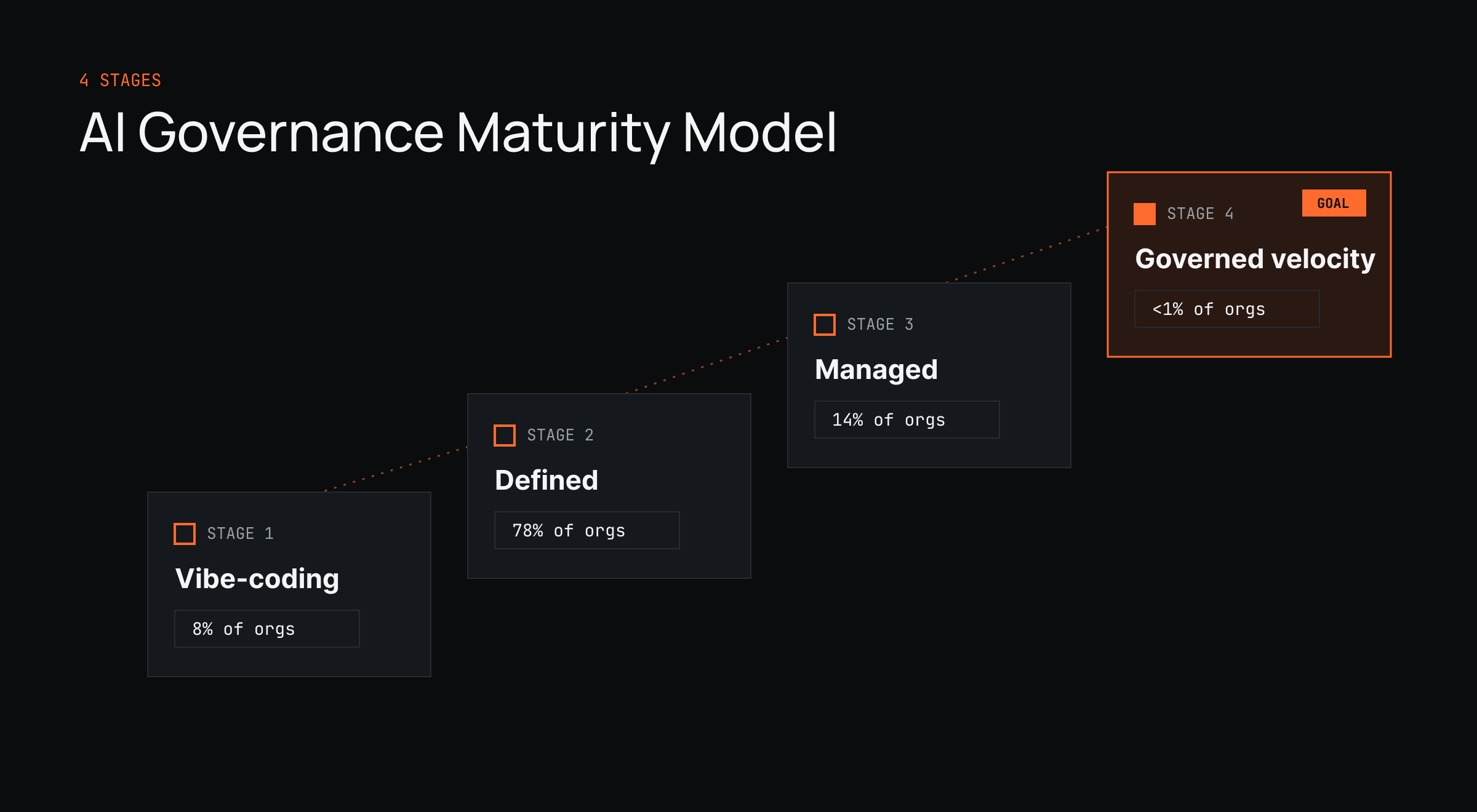
The model runs four stages, from ungoverned vibe-coding to governed velocity. The stages map to the organizational maturity stages in Accenture and Stanford's 2024 study.
Stage 1 – Vibe-coding: ungoverned by default
At Stage 1, AI shows up wherever someone wants it. There is no inventory, no risk tier, no owner.
This is where uncontrolled slop is generated: token-burning prompts, copy-pasted output from AI tools, shadow systems no one reviewed.
Around 8% of organizations sit at this ad hoc stage, per Accenture's 2024 study with Stanford.
The fix is the first piece of structure: knowing what AI capabilities you have.
Stage 2 – Defined: policy on paper
Stage 2 is the crowded middle. A strategy exists, an ethics charter is written, and maybe a council meets.
What is missing is enforcement. The governance policies never touch the pipeline, so engineers route around them.
78% of organizations have built this kind of data governance program on paper – the single most common and most exposed maturity level.
Sitting at Stage 2 feels safe, but it is the opposite because investment stalls while exposure grows.
Stage 3 – Managed: governance layer in the workflow
Stage 3 starts when controls stop living in a document. Risk gates, reviews, and continuous monitoring run inside the software delivery lifecycle.
Only 14% of organizations have reached this point, where current governance practices are systematically implemented rather than aspirational.
The transition from Stage 2 to Stage 3 is the hardest part of the model. It is also the one that improves AI governance from a liability into a working control.
This is the first stage a CTO can defend in front of an auditor.
Stage 4 – Governed velocity: continuous and automated
Stage 4 is reached when checks run on every change, and the audit trail writes itself.
Effectively, no organizations have fully operationalized this, which makes mature AI governance a wide-open field.
At Stage 4, governance stops being a tax on delivery and becomes the reason you can ship faster, because nothing waits on a manual review.
That is governed velocity: the same controls that satisfy a regulator also turn governance into a competitive advantage.
How mature is your AI governance? A checklist for CTOs
Score yourself fast with this structured assessment. Read each line and count the ones you can answer yes to today. Your maturity level is the weakest true answer here, not the best intention.
Data
- You keep a current inventory of every AI system, including procured and embedded ones.
- You can trace the data each system uses back to its source for data integrity.
Process
- Every new AI use case passes a risk assessment before it ships.
- Controls run inside the pipeline, not in a separate document.
- You can produce an audit trail for any AI model decision on request.
People
- Each AI system has a named owner accountable for its outcomes.
- Your board sees AI risk through regular ethical oversight.
Governed velocity
- Governance checks are automated and run on every change.
- Adding governance has made delivery faster.
Mostly blank? You are at Stage 1 or 2, the same place as most organizations. The next section is the way up.
The 4 principles that move you to governed velocity
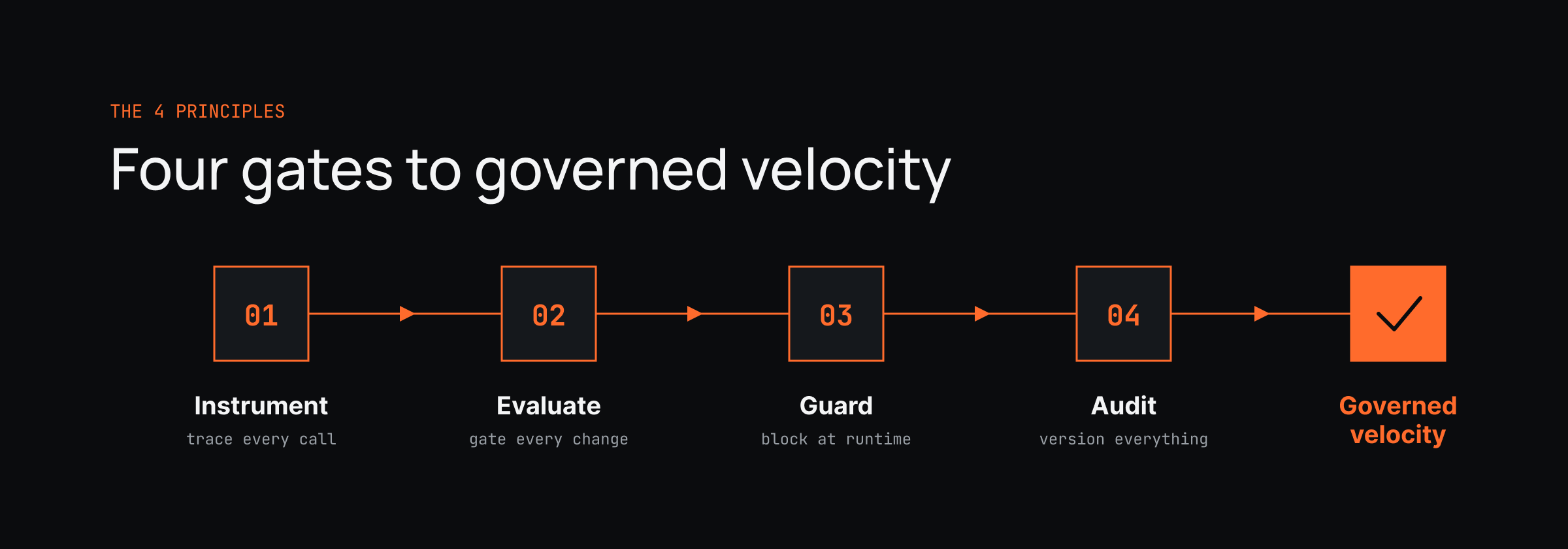
The stages tell you where you are. The four principles below are the gates that move you up – build them in order, and each stage becomes reachable.
They are the engineering form of governed velocity: instrument, evaluate, guard, then make the whole thing auditable.
Principle 1: Instrument before you govern
If you can't debug a system you didn't instrument, you can't govern one either. According to Kanerika's comparison of LLM observability platforms, teams climb through four maturity levels, from ad-hoc logging to closed-loop automated eval gates with drift alerting.
Most teams building agents today are stuck at level 1 while shipping level-4 claims to stakeholders.
See how this plays out for autonomous agents in AI Agent Observability: How to Make Autonomous Agents Auditable.
What to log, trace, and monitor?
The OWASP Top 10:2025 formalizes Security Logging and Alerting Failures as its own risk category this year. It's a direct response to teams shipping AI features with no audit trail.
According to Harness's 2025 State of Software Delivery report, 67% of developers already spend more time debugging AI-generated code than they expected. Without traces, debugging happens by guesswork.
At a minimum, log the prompt version, model, token counts, latency, eval scores, and guardrail result for every call:
{
 "trace_id": "a3f9-7c21-...",
 "span": "llm.completion",
 "model": "provider/model-name-v1",
 "prompt_version": "v14",
 "input_tokens": 812,
 "output_tokens": 340,
 "latency_ms": 640,
 "eval_scores": { "faithfulness": 0.92, "toxicity": 0.01 },
 "guardrail_result": "pass"
}
If you're integrating agents against third-party APIs, AgentBridge, our open-source API integration framework, traces every call by default rather than bolting it on later. You cannot govern behavior you cannot see; tracing is the prerequisite, not an add-on.
Principle 2: Replace manual review with automated evals
Manual review doesn't scale past a handful of prompts. Evals do.
They're dataset-driven test suites that score every model change the way unit tests score every code change, per DEV Community's practical guide to CI/CD-integrated AI evals.
The guide describes deterministic checks paired with LLM-as-judge scoring, run against a fixed dataset on every pull request. This is AI code quality governance in practice.
Gating merges and deployments
Gating means the merge fails when the eval score drops, the same way it fails when a unit test breaks. This is the difference between an advisory dashboard and an actual gate.
An eval that doesn't block a merge is a dashboard, not a gate.
name: eval-gate
on: [pull_request]
jobs:
 run-evals:
   runs-on: ubuntu-latest
   steps:
     - uses: actions/checkout@v4
     - name: Run eval suite
       run: python evals/run.py --dataset regression_set.jsonl
     - name: Enforce threshold
       run: |
         SCORE=$(cat eval_score.txt)
         if [ "$SCORE" -lt 90 ]; then
           echo "Eval score $SCORE below threshold, failing build"
           exit 1
         fi
Principle 3: Enforce guardrails at runtime
The NIST Generative AI Profile, published in July 2024 as an extension to the AI RMF, gives you the categories to encode: transparency, accountability, and information integrity.
Encode them as policy-as-code, checked synchronously before a response ships, not as a document your engineers read once.
The risks worth gating against are already ranked: OWASP's 2025 GenAI Top 10 puts prompt injection, sensitive information disclosure, and supply chain risk at the top.
   if detect_prompt_injection(context.input):
       return block("prompt_injection_detected")
   if contains_pii(response) and not context.pii_allowed:
       return block("sensitive_info_disclosure")
   if not verify_source(context.tool_calls):
       return block("supply_chain_risk")
   return allow(response)
Handling drift and edge cases
Drift shows up as incidents, not warnings. According to Stanford HAI's 2026 AI Index Report, documented AI incidents rose to 362 in 2025, up 55% from 233 in 2024.
Closed-loop drift alerting, the fourth rung on Kanerika's observability ladder, is what catches a guardrail that quietly stopped matching production traffic before it becomes incident number 363.
Guardrails that only run in code review miss the traffic that actually reaches production.
Principle 4: Make governance auditable by default
Treat every prompt, model version, and eval dataset like source code: versioned, diffable, revertible.
The AI-MM SET maturity model on GitHub frames this as one axis of engineering maturity, alongside tooling integration and governance.
Map it to the NIST AI RMF functions, Govern, Map, Measure, and Manage, and you have a structure an auditor, not just an engineer, can follow.
This is the same discipline we bring to architecture and code review engagements: version control isn't optional once AI is writing production code.
When prompts, models, and evals are already versioned, mapping to the NIST Generative AI Profile becomes documentation, not a fire drill. Compliance paperwork stops being a project once the audit trail already exists in your pipeline.
See which AI tools cover this in AI Governance Tools Comparison (2026): Platforms, Frameworks, and Solutions.
See how that applies to regulated code in AI Governance Compliance: How to Keep AI-Generated Code Secure and Compliant (SOC 2, HIPAA).
Outcomes of mature AI engineering
According to Google Cloud's coverage of the 2025 DORA Report, 90% of surveyed tech professionals already use AI at work. The same report found AI adoption boosts throughput but drags down delivery stability, unless it's paired with platform investment.
DORA's platform engineering capability research explains why: automated testing, security review, and standardized deployment convert individual AI productivity gains into a stable, organization-wide result.
Skip those controls, and Harness's 2025 State of Software Delivery report shows what happens next. 92% of developers say AI-generated code increases deployment blast radius, and 68% spend more time on AI-introduced security remediation.
A governance framework you can apply this quarter
You don't need a governance department to start. You need twelve weeks and a practical roadmap that enforces what you already know.
We built this exact discipline into Atlas, our ticket-to-tested-PR workflow. It's the responsible AI standard that puts governed AI engineering – Platform, Agents, Workflow – inside your development lifecycle.
A ticket comes in, an agent drafts the change, evals score the diff, and guardrails check it at runtime. A human then reviews a PR that has already passed the same gates a senior engineer would apply. Nothing ships without a trace attached.
It's the same principle behind our AI agent development services and the process for how we estimate production AI agent work.
Governance isn't a phase after delivery; it's built into the pipeline that produces the PR. Mature AI engineering doesn't eliminate incidents; it catches them before your customer does.
Summary: Governed velocity is reached one stage at a time
An AI governance maturity model is a map from where your AI program sits today to controls that run themselves and speed you up.
Most organizations are stuck at the same rung: policy on paper, nothing in the pipeline. The way up is operational – instrument, evaluate, guard, audit – one gate at a time.
Governed velocity is the only stage where governance and speed stop trading off against each other.
Want to see your current stage and the fastest route to the top? Explore how Atlas runs governance inside the engineering workflow, or talk to Blazity's AI-engineering team about a maturity assessment.
FAQ on AI governance maturity models
What is an AI governance maturity model?
An AI governance maturity model scores how consistently your organization can trace, test, and control AI behavior before production, measured by engineering controls rather than policy coverage. It reads two lenses: the stage you sit in, and the principles that move you up. Your real level is what runs in the pipeline, not what a charter claims. The point is to turn a vague question into something you can measure.
How is vibe coding different from AI engineering?
Vibe coding is prompt-driven output with no gate; responsible AI engineering adds tracing, evals, and runtime guardrails so the same output is testable and auditable. One ships on vibes, the other ships on evidence. The maturity model is the path between them.
Do evals replace human review entirely?
No, evals catch regressions at scale; humans still own edge cases, ambiguous judgment calls, and the eval datasets themselves. The gate handles volume so people can handle judgment.
How long does it take to reach measurable AI governance maturity?
AI Teams following the twelve-week framework above typically have instrumentation, evals, and guardrails running before the quarter ends. Auditable versioning follows once those three are stable. Plan in quarters, not weeks, and reassess your maturity level annually as your AI footprint grows.
Sources
- Accenture and Stanford HAI, Responsible AI: From compliance to confidence (2024)
- Diligent Institute, AI governance and the Q4 2025 GC Risk Index
- Stanford HAI, The 2026 AI Index Report
2025 Top 10 Risk & Mitigations for LLMs and Gen AI Apps – OWASP GenAI Security Project (2025) - OWASP Top 10:2025
- Announcing the 2025 DORA Report – Google Cloud Blog (2025)
- Capabilities: Platform engineering – DORA
- What's your company's AI maturity level? – MIT Sloan (MIT CISR)
- The State of Software Delivery 2025 – Harness (2025)
- LLMOps Observability: LangSmith vs Arize vs Langfuse vs W&B – Kanerika
- A Practical Guide to Integrating AI Evals into Your CI/CD Pipeline – DEV Community
- Beyond Vibe Coding: The Maturity Spectrum – AI Advances
- AI-MM SET: AI Maturity Model for Software Engineering Teams – GitHub
%201.svg)