
AI governance solutions are the policies, controls, and tooling that keep AI systems under control across their full lifecycle, from the data a model reads to the code an agent ships.
In an engineering context, they answer one question: how do you let agents write and merge code at speed without losing track of what they did, what it cost, or whether it is safe?
The short version: governance is no longer a compliance afterthought. It is the thing that decides whether your AI agents reach production at all.
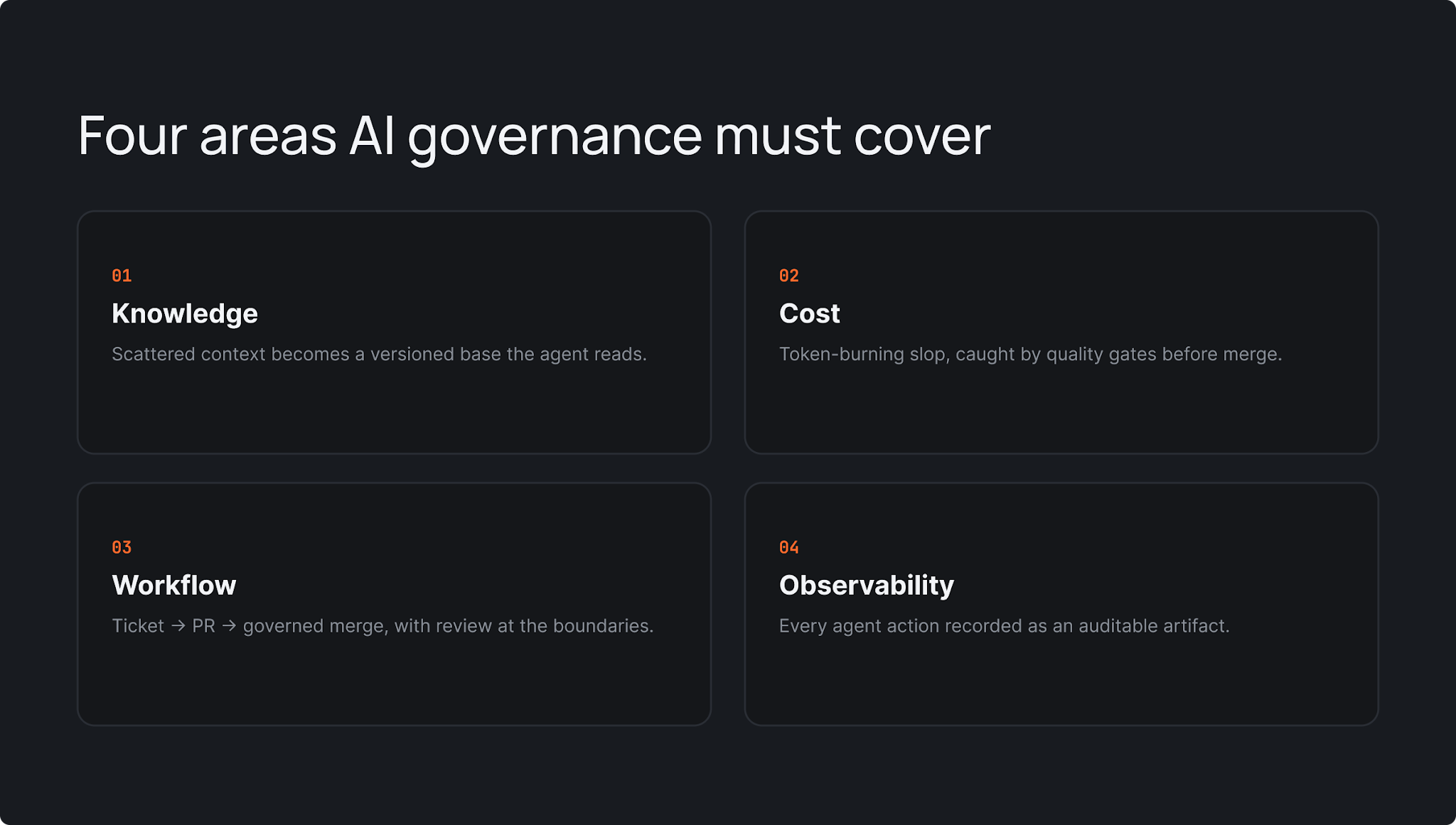
In this guide, you will learn how governed AI engineering works once your team is past the demo stage. You will:
- map the four areas any governance approach has to cover,
- understand why the EU AI Act and NIST AI RMF matter to buyers and regulated teams,
- see where engineering governance fits next to platforms, frameworks, and point tools,
- check where your own team sits on the maturity curve,
- identify which governance layer your team needs.
Key insights
- A 2025 Veracode test found vulnerabilities in 45% of generated code samples across 100+ models and 80+ tasks. Treat it as a benchmark signal, not a permanent claim about every frontier model.
- Adoption is near-universal, but scaling is rare. 88% of organizations use AI in at least one function, yet only about a third have scaled it enterprise-wide (McKinsey, 2025).
- Governance gaps are expensive. Shadow AI contributed to 20% of breaches and added $670,000 to the average breach cost; 63% of organizations had no AI governance policy (IBM, 2025).
- The EU AI Act is in force and can apply outside the EU when EU-market systems or EU-used outputs are involved, with the highest fines reaching €35M or 7% of global turnover.
- Governed velocity is measurable. Internal Blazity benchmarks for Atlas show: +50% features shipped per day, 3x faster validation cycles, and -30% time on manual maintenance (depend on workflow maturity and adoption).
What are AI governance solutions?
AI governance solutions are the combined policies, processes, and software that control how AI systems are built, deployed, and monitored. The term covers everything from a written approval workflow to a runtime that records every action an agent takes.
In practice, AI governance refers to keeping three things true at once:
- you know what your AI is doing,
- you can prove it,
- and you can correct or redirect it when it is wrong.
That is the working definition we use with engineering leaders. It helps to separate two ideas.
For Atlas, the practical goal is governed engineering: visible AI usage, controlled context, and decisions that can be reviewed.
Governance is the operating layer that makes that visible in the development workflow, not a policy paragraph after the fact.
For code-writing agents, the hard part is not knowing which files changed; Git already gives you that. The harder governance problem is understanding how developers use AI, what context agents received, where tokens were spent, what decisions the agent made, and which checks failed.
If you cannot reconstruct that process, you do not have governance, you have hope.
Governed AI engineering treats oversight as part of the build pipeline, not a report you write afterward. Governance software, gates, and audit trails sit inside the workflow where the agent operates.
Why AI governance matters in 2026: shadow AI, slop, and the EU AI Act
Two pressures arrived at the same time.
One is technical: AI agents now write production code, and a lot of it is bad. The other is regulatory: the rules caught up with the AI technologies already in use.
Start with the code. Veracode's 2025 tests across over 100 models found vulnerabilities in 45% of generated samples, including many OWASP Top 10 cases (Veracode, 2025). Some vulnerability classes, including cross-site scripting, performed especially poorly in that test set. The point is that generated code still needs verification, not that every newer model is permanently unsafe.
Do not treat that as a timeless benchmark. Treat it as the slop problem: agents can produce plausible code fast, miss constraints unless the workflow checks them, and burn tokens on work that a human then has to unwind.
Then there is shadow AI: unsanctioned AI use, where people run unapproved AI tools on sensitive data with no data privacy controls. IBM found that shadow AI was a factor in 20% of breaches and added $670,000 to the average breach cost, while 63% of organizations had no AI governance policy at all (IBM, 2025).
The pattern is consistent. Governed AI adoption lags behind the AI initiatives already in production, and the gap is where cost and risk accumulate.
Without governance, you cannot manage AI risk because you cannot see it.
Security teams cannot protect what they cannot track without security controls, and auditors cannot sign off on what was never recorded.
The right controls are what let you reduce risk you can finally measure, and regulation now assumes you have them.
How to govern the entire AI lifecycle?
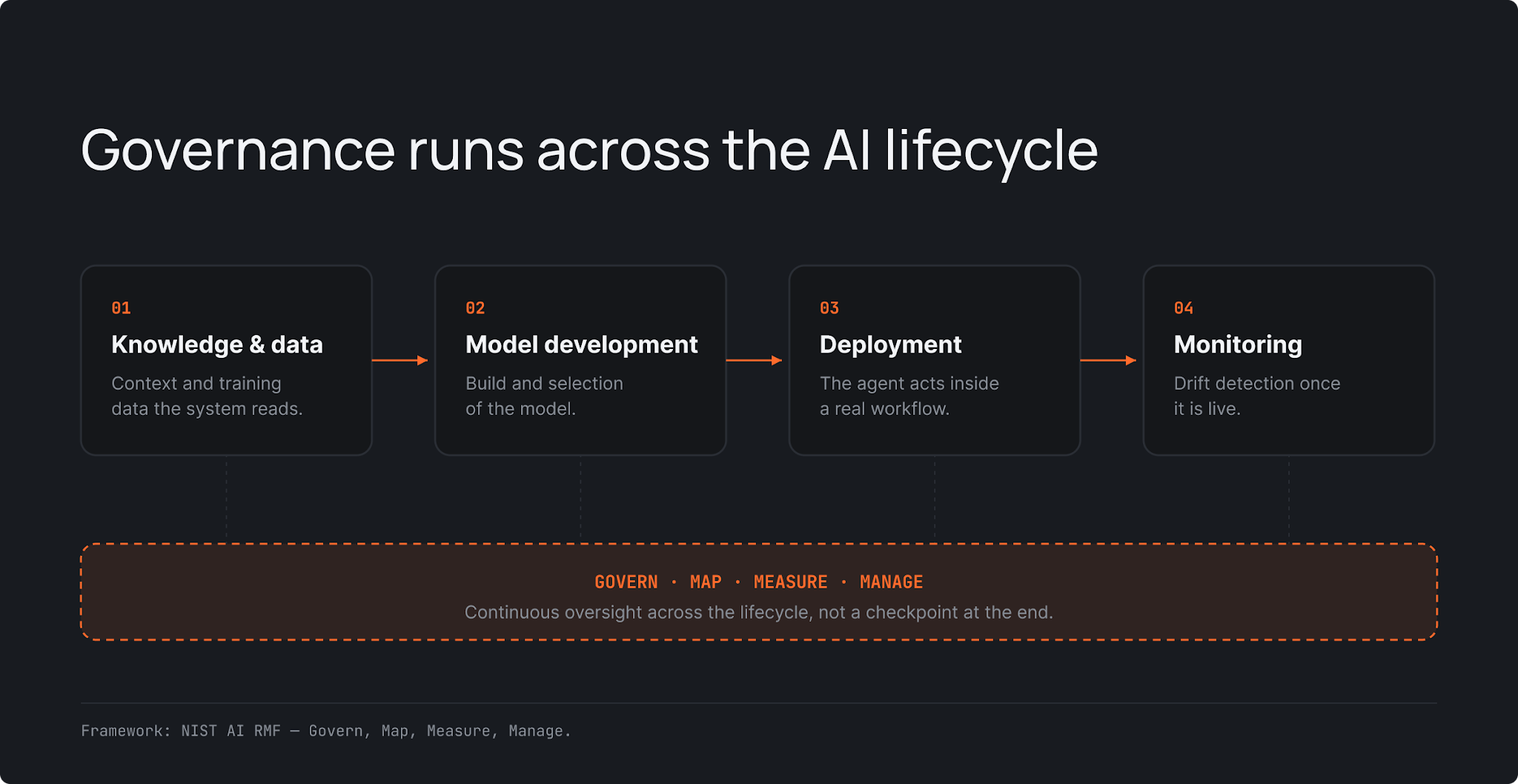
Governance is not a checkpoint at the end. It runs across the entire AI lifecycle, because risk enters at every stage and compounds across AI workloads if you wait.
Think of the lifecycle in four stages:
- the knowledge and training data a system reads,
- AI development and model selection,
- deployment into a workflow,
- and ongoing monitoring once it is live.
Each stage introduces its own failure mode.
Bad context and poor data quality produce wrong output. Weak gates let insecure code through. No monitoring means drift goes unnoticed until something breaks in production.
This is why one-off reviews fail: AI systems evolve as data, prompts, and dependencies change, so risk and AI system performance shift after launch, not just before it.
McKinsey's data shows the cost of skipping this: 88% of organizations use AI, but only about a third have scaled it across the enterprise (McKinsey, 2025). Most are stuck in pilots and stalled AI projects that never reach production.
The teams that scale are the ones that built oversight, monitoring, and clean context before they needed them.
Check where you stand today in the AI Governance Maturity Model: From Vibe-Coding to Governed Velocity.
4 problems AI governance solutions must solve
Strip away the vocabulary, and every governance challenge in production reduces to four problems. Each has a symptom you can feel, a business cost you can measure, and a fix you can build.
Left unmanaged, these four become the main Risks of Deploying AI Agents in Production. We treat them as one connected substrate rather than four separate tools.
Learn more about each in Top 4 AI Governance Challenges in Production.
1. Scattered, inconsistent knowledge
The symptom: your product and engineering knowledge lives in Slack threads, Confluence pages, and people's heads, in formats that disagree with each other.
An agent is only as good as the context it reads. Feed it fragmented knowledge, and it produces fragmented work, then a human spends the saved time correcting it.
The fix is a managed, versioned context that the agent reads from, not a two-page prompt copied between projects.
See how to build and govern that context in Agentic Context Engineering: How to Govern the Knowledge Your AI Agents Read.
2. Token-burning slop and weak quality gates
The symptom: agents generate large volumes of code, much of it insecure or unnecessary, and your review queue grows faster than your output.
The cost is direct. Unfiltered agent output becomes a security backlog and a token bill with little to show for it. The fix is machine-enforced quality gates that catch problems before merge.
3. No workflow architecture
The symptom: agents act, but no defined path connects a ticket to a reviewed, merged change. Work happens, then nobody can reconstruct how.
Without a workflow, you get either chaos or governance theater, where humans rubber-stamp everything and velocity dies. Neither scales.
The fix is a defined path from ticket to pull request to governed merge, with human review at the boundaries and agent execution inside them.
4. No observability or audit trail
The symptom: you cannot see the underlying AI behavior, which tools the agent called, which files it read, or which steps it took. The work is invisible after the fact.
In regulated industries, this is disqualifying. You cannot demonstrate compliance during an audit if there is no audit trail.
The fix is an observable architecture that records every action as audit evidence, with real-time monitoring and drift detection in the monitoring phase.
Get the full approach in AI Agent Observability: How to Make Autonomous Agents Auditable.
Regulatory context: how do the EU AI Act and NIST AI RMF shape AI governance?
This section is here for buyer and compliance context. Two reference points shape what regulators and buyers now expect: the European Union's AI Act, which is binding law, and the NIST AI RMF, which is voluntary guidance that often functions as a shared enterprise language.
They work at different layers, so most teams need to satisfy both. The table compares them at a glance before we break each one down.
The EU AI Act: binding and risk-based
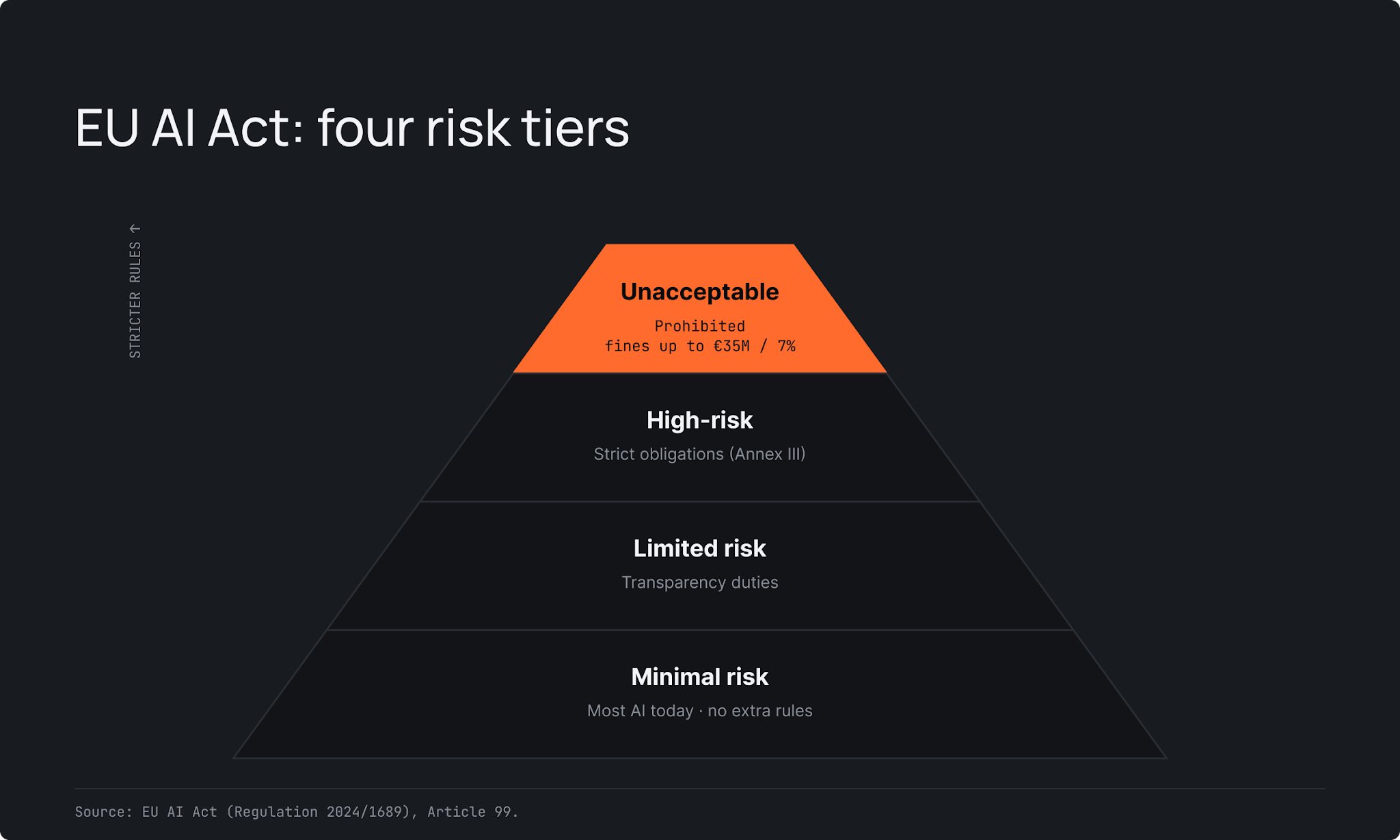
The EU AI Act entered into force on 1 August 2024 and applies a four-tier, risk-based model (European Commission). Your regulatory obligations scale with the risk level of each system, from minimal to high-risk. Prohibited practices have applied since February 2025, and general-purpose AI model obligations since August 2025.
Timing matters here, because the Act applies in phases. Prohibited practices and AI literacy obligations started in February 2025, GPAI obligations started in August 2025, broad application is set for August 2026, and some high-risk obligations have later deadlines under the EU's current simplification timeline.
Do not rely on the latest date as a free pass. High-risk use also brings impact assessments and data protection duties, and the penalties are why this reaches the board: violations of prohibited practices carry fines up to €35M or 7% of global turnover, higher than GDPR.
The NIST AI RMF: voluntary but expected
The NIST AI RMF 1.0, published in January 2023, organizes risk management into four functions: Govern, Map, Measure, and Manage (NIST). As a risk management framework, it pairs with ISO/IEC 42001, and it is increasingly written into AI governance requirements for US procurement.
There is a common failure pattern worth naming. Teams write the policy (Govern), produce an AI inventory (Map), then quietly drop Measure, the part that turns managing risk into real risk assessments, because they have no data governance or infrastructure to benchmark against.
The framework then lives on the intranet while the actual work stays unchanged, which is policy without practice.
Regulators are not slowing down either: US federal agencies introduced 59 AI-related regulations in 2024, more than double the 25 in 2023 (Stanford HAI, 2025).
Together, they push buyers toward audit-ready documentation, continuous monitoring, and compliance processes you can evidence on demand.
For the engineering controls behind that evidence, see AI Governance Compliance: How to Keep AI-Generated Code Secure and Compliant (SOC 2, HIPAA).
Where engineering governance fits in the AI governance stack?
The market mixes different layers under one label. For engineering teams, the useful question is what layer you need to govern: the development workflow, the enterprise AI program, the risk framework, or a specific point in the stack.
Engineering governance solutions
An engineering governance solution gives you the building blocks that make agent work reviewable: rules, context, review artifacts, workflow controls, and evidence. It drops into the workflow you already run rather than replacing it.
Atlas, Blazity's AI governance solution for shipping production software with agents, sits here. It keeps governance close to the repo and the engineering workflow: context, rules, skills, review artifacts, and implementation patterns on infrastructure you can defend.
It is not a point tool that governs one thing, and not a platform that owns your stack. This is the category to start from if you ship production software with agents: governed, but with no replatforming and no vendor lock-in.
AI governance platforms
A governance platform offers centralized governance: one system, such as IBM watsonx, that wants to own model inventory, AI metadata, monitoring, and policy enforcement end-to-end.
Platforms give you breadth, but often require you to route your work through them, which can mean a replatform you did not ask for.
AI governance frameworks
A framework, like the NIST AI RMF, is a set of outcomes and practices, not software. It tells you which risks to address, not how to enforce them in code.
Frameworks are the shared language between your security, legal, and product teams. You still need tooling to keep them operational day to day.
AI governance tools and software
AI governance software in this category comes as point products: a bias detector here, a model-monitoring service such as Fiddler there, an audit-logging tool for your data governance practices elsewhere.
Each solves one problem well, but the risk is a patchwork of disconnected tools that nobody has stitched into a single, observable workflow.
Compare major AI tools on the market in AI Governance Tools Comparison (2026): Platforms, Frameworks, and Solutions.
How mature is your AI governance? Checklist for engineering leaders
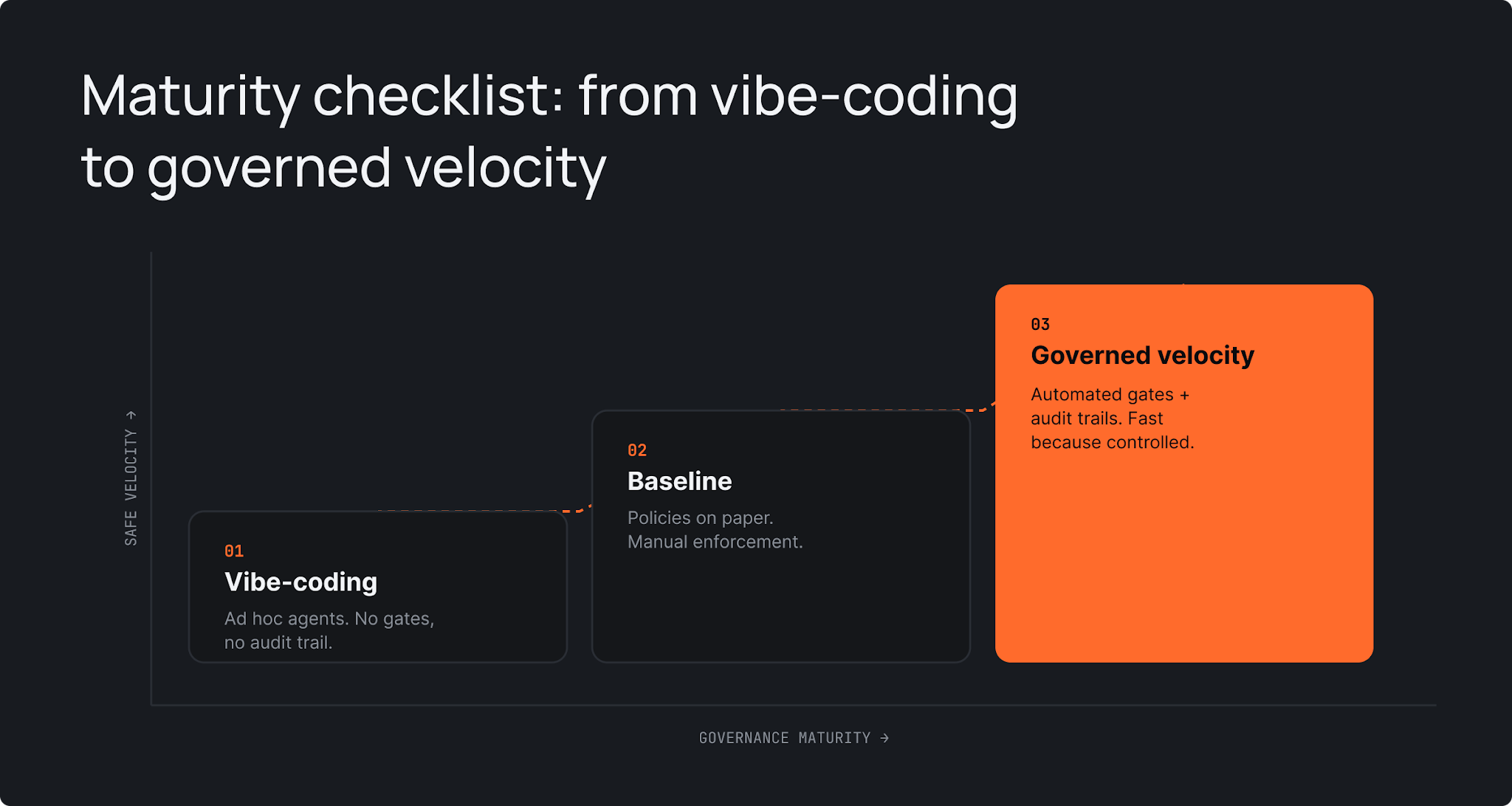
Effective AI governance runs along a spectrum, and most teams sit lower than they think. Run this checklist against your AI implementation before you decide what to buy or build.
- Can you see every action an agent takes, or only its final output?
- Do quality gates run automatically before merge, or is review still manual?
- Is your agent's context a versioned, managed base, or a prompt copied between projects?
- Can you produce an audit trail on demand for any change an agent made?
- Does monitoring catch drift after deployment, or do you find out when something breaks?
Mostly "no" puts you at vibe-coding: fast until the review queue and the security backlog catch up.
A common baseline is governance that exists on paper, while enforcement stays manual and inconsistent.
Mostly "yes," with the controls automated, is governed velocity: agents move fast precisely because the gates and audit trails are built in.
At that level, governance practices are enforced by the system, not left to memory.
How to choose an AI governance solution? 2026 recommendations
Most teams buy governance under time pressure, which is exactly when the wrong criteria win.
The first thing to understand is that these tools sit at different layers, so the right choice depends on the gap you have. Done well, this keeps engineering teams shipping without turning every agent run into a manual review queue.
Most categories cover a single layer. An engineering governance solution covers the development layer: repo-owned context, agent rules, review artifacts, workflow controls, and evidence about how AI-assisted work happened. Standards, enterprise governance, and observability layers then sit alongside it.
These are complements, not substitutes: an engineering governance solution and a model-governance platform solve different problems.
When you evaluate options, three requirements separate the strong from the weak.
- Require no replatform and no vendor lock-in, so adoption fits the stack you already defend.
- Require audit-ready documentation you can hand to an auditor, not just dashboards.
- And require that it record what agents actually do, not only their final output.
An engineering governance solution is built to meet all three, which is why it is the place most engineering teams should start.
Atlas: AI Governance Solution for AI engineering
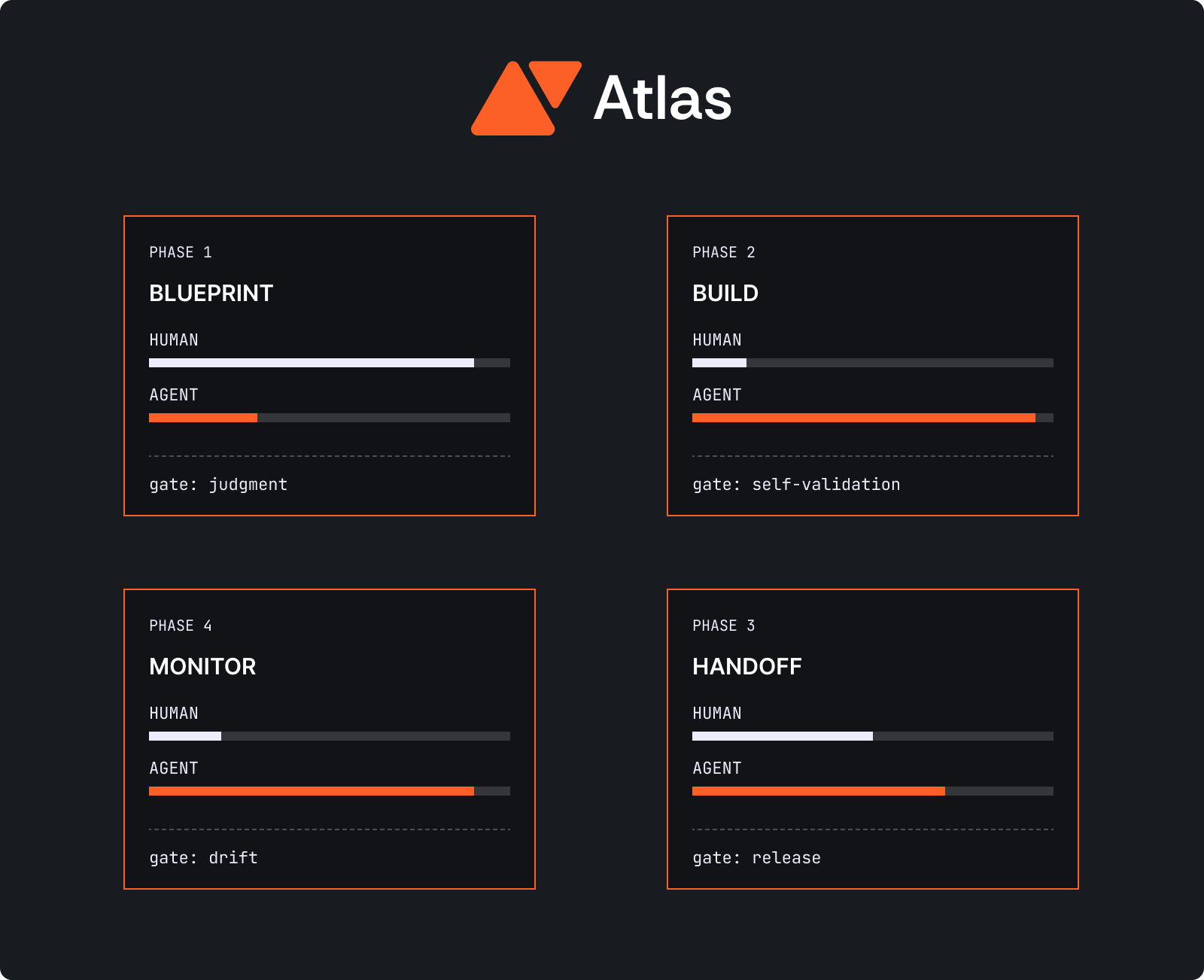
Atlas is Blazity's answer to the four problems above: an AI governance solution for the engineering process, not a platform that demands you move everything onto it. It puts repo-owned context, rules, skills, review artifacts, and workflow governance inside your development lifecycle.
It maps cleanly to the four areas.
Atlas Core is the managed context substrate (repo memory, rules, skills, templates, review artifacts) that the agent reads, so knowledge stops being scattered.
Quality gates, evaluations, and self-validation address slop when they are part of the workflow around the agent, not just a prompt instruction.
AI Workflow is the implementation surface for the ticket-to-PR path: a defined route from ticket to pull request to governed merge, with machine-enforced gates where the workflow owns them.
Observability should record the agent run, decisions, tool calls, context, and failed checks as evidence. Atlas connects those artifacts to the repo-owned process rather than becoming a separate black-box platform.
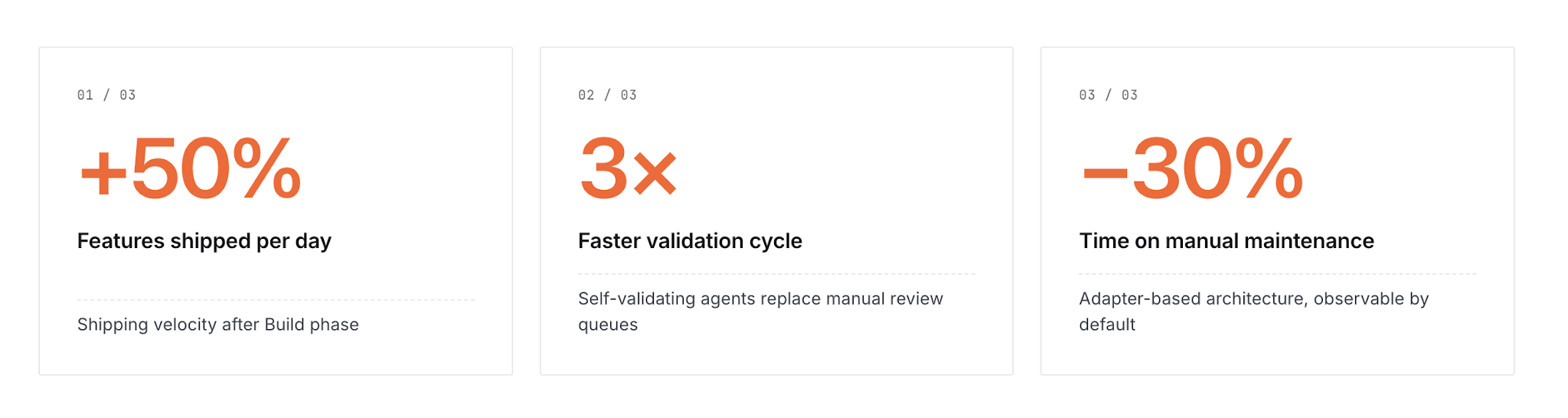
Teams use Atlas to target outcomes like +50% features shipped per day, 3x faster validation cycles, and -30% time on manual maintenance, depending on workflow maturity and adoption. The payoff is directional, not a guaranteed benchmark.
Atlas is built to govern the engineering process you already run, not to replace it, which is what "autonomous, but governed" means in practice. It starts from repo-owned context and review artifacts, then connects to workflow, gates, and observability where those surfaces are implemented. See the GitHub repo.
To sum up: Governance is what decides whether your AI agents reach production
AI governance solutions exist to do one thing: let AI agents build and ship at speed while you keep control of what they do, what it costs, and whether it is safe. That control reduces to four areas: knowledge, cost, workflow, and observability.
The pressure is real on both sides. AI-generated code still needs verification, governance gaps drive expensive breaches, and the EU AI Act now makes oversight a legal requirement for many teams, not a preference.
The teams that win are not the ones with the most pilots, but the ones that built governed velocity, where the controls are automatic, and the agents move fast because of them.
If your agents are producing more code than you can safely review, start with a governance and architecture assessment.
Talk to Blazity or explore Atlas to see how an AI governance solution fits your existing stack.
FAQ on AI governance
What is governed AI engineering?
Governed AI engineering is the practice of building software with AI agents while keeping every action visible, provable, and reversible. It puts oversight, quality gates, and audit trails inside the build pipeline rather than treating governance as a report written afterward.
Does the EU AI Act apply to AI-generated code?
It can. If you build an AI system whose output is used in the EU, you are likely in scope, regardless of where your company is based. Whether you face high-risk obligations depends on the use case, but transparency and documentation expectations apply broadly, and penalties reach €35M or 7% of global turnover for the most serious violations.
What is the difference between an AI governance platform and an engineering governance solution?
A platform is a centralized system that wants to own model inventory, monitoring, and enforcement end-to-end, which often means routing your work through it. An engineering governance solution gives you repo-owned rules, context, review artifacts, and workflow controls that fit the development process you already run, without a replatform.
Is the NIST AI RMF mandatory?
No, the NIST AI RMF is voluntary guidance. In practice, it functions as a de facto standard because US federal procurement and many enterprise buyers ask vendors to demonstrate alignment with its four functions: Govern, Map, Measure, and Manage.
How do you prevent AI agents from shipping insecure code?
With machine-enforced quality gates that run before merge: static analysis, evaluation checks, and policy gates, combined with self-validation in the agent itself. Human review stays at the boundaries, where judgment matters, while automated gates handle the volume that manual review cannot.
Sources
- McKinsey, The State of AI (2025)
- Veracode, 2025 GenAI Code Security Report
- IBM, Cost of a Data Breach Report 2025
- European Commission, Regulatory framework on AI (EU AI Act)
- EU AI Act, Article 99: Penalties (Regulation 2024/1689)
- NIST, AI Risk Management Framework
- Stanford HAI, 2025 AI Index Report: Policy and Governance
%201.svg)