
AI governance compliance for AI-generated code means applying security, privacy, access, change-management, and evidence controls to AI-assisted development. It covers code-generation tools, coding agents, prompts, tool calls, repositories, dependencies, credentials, reviewers, and deployment systems.
AI governance compliance requires you to control the entire coding workflow across the AI lifecycle, not merely inspect the code produced by an AI model.
I start with agent identity, restrict tools and data, isolate changes, require human approval, and preserve evidence that an auditor can reconstruct.
That approach matters for regulatory compliance because SOC 2 evaluates controls over systems and services, while HIPAA safeguards cover access, activity review, integrity, authentication, and transmission security.
In this guide, you will learn:
- What AI governance compliance means for AI-generated code?
- How SOC 2 and HIPAA obligations apply to AI coding workflows?
- Which control questions every AI coding agent must answer?
- How to enforce least privilege and controlled changes?
- How to build a SOC 2 and HIPAA checklist for AI adoption?
Key insights
- AI-generated code becomes a governance concern when agents can access repositories, credentials, production systems, or regulated data.
- Separate agent identities make authorization, review, and incident investigation easier to prove.
- A pull request records the result of a change, while an audit trail must also explain the task, prompt, tools, approvals, and deployment outcome.
- SOC 2 and HIPAA controls require evidence about access, activity, integrity, authentication, and data transmission.
- Atlas adds development-layer controls around repository context, agent permissions, machine-enforced gates, and review artifacts.
- Continuous monitoring, human oversight, and audit trails turn AI governance from policy into practice.
What is AI governance compliance for AI-generated code?
AI governance compliance for AI-generated code means applying security, privacy, access, change-management, and evidence controls to AI-assisted development. The scope includes code-generation tools, coding agents, prompts, tool calls, repositories, dependencies, credentials, reviewers, and deployment systems.
A useful boundary is the complete change path:
- Someone defines a task.
- An agent receives selected context.
- The agent calls tools and creates or modifies files.
- Automated checks inspect the change.
- A human reviews and approves it.
- A deployment system releases it.
- Your organization retains evidence of what happened.
SOC 2 is a reporting framework built around controls evaluated against the AICPA Trust Services Criteria, one of the governance frameworks buyers ask about. The criteria cover Security, Availability, Processing Integrity, Confidentiality, and Privacy, according to the AICPA’s 2017 Trust Services Criteria resource with revised points of focus, dated September 30, 2023. HIPAA adds specific expectations for covered entities and business associates handling protected health information.
As of 2026-07-22, HHS describes technical safeguards involving access control, audit controls, integrity, authentication, and transmission security in its HIPAA Security Rule summary, last reviewed March 19, 2026. A proposed update to that Security Rule would make measures like encryption and multi-factor authentication mandatory. As of mid-2026, it remains proposed with final action delayed, so plan against both the current rule and the proposed changes.
AI governance compliance starts with controlling the development path that produces and releases code.
For the wider governance picture across knowledge, cost, workflow, and observability, read AI Governance Solutions: The Complete Guide to Governed AI Engineering (2026).
Why do SOC 2 and HIPAA obligations follow the pipeline?
An AI-generated function does not carry a useful compliance status by itself. The surrounding workflow determines who authorized the task, what information reached the model, which tools were available, and whether the resulting code passed review.
For SOC 2, an auditor may need to understand how your organization restricts repository access, reviews changes, handles production credentials, and detects unauthorized activity and compliance risk.
A developer using an AI assistant does not remove those control questions. HIPAA introduces a narrower data boundary. If an agent can read application logs, fixtures, tickets, database exports, or test data containing protected health information, the workflow must account for that exposure.
The question is whether the agent saw sensitive information while producing the code.
That distinction changes how you design prompts, retrieval, tool permissions, test environments, logging, and data security. It also changes how you investigate an incident when a credential or data set crosses the wrong boundary.
Where does the EU AI Act change the risk conversation?
The European Commission describes Regulation (EU) 2024/1689 as a risk-based legal framework for trustworthy AI on its AI Act policy page, last updated July 7, 2026.
As of July 2026, most high-risk obligations under Annex III apply from August 2, 2026, but the Commission’s Digital Omnibus proposal would defer them to December 2, 2027 for Annex III systems and August 2, 2028 for embedded AI. Plan against both the current and the revised dates.
High-risk AI systems also require conformity assessments before market placement, and many teams align with the OECD AI principles as a shared baseline for responsible AI development.
For engineering teams, the practical implication is a risk conversation, AI risk management, and clear risk assessments before implementation. Ask what the AI application does, who relies on it, what decisions it influences, and whether the AI-generated code supports a higher-risk use case.
That does not make every coding assistant a high-risk AI system. It does mean your development controls should preserve enough context to explain how an AI-assisted change entered a regulated product.
The Commission’s implementation materials may change over time as emerging AI regulations evolve, so verify current regulatory requirements before publishing a control policy or relying on a specific risk classification.
Keep the legal analysis and ethical considerations separate from your engineering controls, then connect them through documented ownership.
The 4 control questions every AI coding workflow must answer

I use four control questions to test an AI coding workflow before discussing tools. They expose gaps faster than a broad policy statement.
The answers should exist at the level of a specific task and change. The questions are:
- Who or what had access?
- What changed?
- What data did it touch?
- Who approved it?
These questions apply to a local coding assistant, a hosted model, or an autonomous agent that opens pull requests. They also apply when the model provider is outside your organization.
A general statement that “the team reviews AI output” does not explain which agent acted, what it could access, or which reviewer approved the resulting diff.
A control is useful when it answers a specific question about a specific change.
Who or what had access?
Start by identifying every principal involved in the task:
- The human who created or assigned the task
- The AI agent or service identity
- The model provider
- The repository and branch
- The tools available to the agent
- The credentials issued during execution
- The systems reached through those tools
A shared developer token creates an attribution problem. If an agent commits through a human account, your audit record may show that person even if they did not create, inspect, or approve the change. Give each agent a distinct identity with a defined owner.
Record the task, repository, branch, permissions, start time, end time, and tool calls associated with that identity.
That record supports access review and incident response. It also lets you revoke one agent’s access without disabling a developer’s broader account.
What changed, what data did it touch, and who approved it?
A diff shows modified files, but it does not explain the context that shaped the change.
Pair the diff with the task description, relevant prompt or instruction, retrieved files, tool calls, test results, scanner output, review comments, approval, and deployment result. Data handling deserves its own field.
Record whether the agent touched source code, secrets, production-like data, protected health information, customer content, or external services.
You do not need to expose sensitive prompt contents to every reviewer. You do need a protected record proving what the agent received and what it attempted to access.
Approval should identify a human reviewer and the change boundary they reviewed. A green test run cannot stand in for a decision about authorization, privacy, or architectural risk.
How to enforce identity and least privilege for coding agents?
AI coding agents need permissions designed for a task, not inherited from the developer who launched them.
The default should be a narrow operating boundary that can be inspected, changed, and revoked. I treat agent access as a temporary session with explicit capabilities.
The agent may read selected repository paths, write to an isolated branch, run approved commands, and request additional access through a visible process.
That model reduces the blast radius of prompt injection, malicious dependencies, accidental disclosure, faulty tool use, and other AI-related risks, and it supports third-party risk management around model providers. It also produces clearer evidence for SOC 2 access reviews and HIPAA security investigations.
The stakes are measurable: IBM’s 2025 report found shadow AI factored into 20% of breaches and added $670,000 to the average breach cost.
These failures recur in production; see the Top 4 AI Governance Challenges in Production (and How to Solve Them).
Per-agent identities, short-lived credentials, and scoped tools
Create an identity for each agent or agent class, then bind that identity to an owner and task. A coding agent working on a frontend issue should not inherit credentials for deployment, production databases, or unrelated repositories.
Use short-lived credentials where the infrastructure supports them.
Scope each token to the repository, branch, command set, and duration required by the task. Tool permissions should reflect the same boundary. Reading a file, editing a file, installing a package, opening a network connection, and merging a pull request are different capabilities.
Put higher-risk actions behind explicit approval. Examples include changing authentication logic, modifying infrastructure, accessing customer data, adding dependencies, and running deployment commands.
Your logs should capture denied actions as well as successful actions. A blocked attempt can reveal a prompt injection or a task that was scoped incorrectly.
Secret isolation and sensitive-data boundaries
Agents should not receive ambient access to environment variables, cloud credentials, package registries, or local configuration files. Mount only the material required for the task, and keep secrets outside the model-visible context whenever possible. Use secret brokers, isolated runners, redacted logs, and allowlisted network access.
Treat package installation as a separate boundary because install scripts and dependency resolution can invoke tools beyond the coding task. For HIPAA workflows, keep protected health information out of prompts, fixtures, logs, training data, and generated artifacts unless the approved architecture specifically permits that handling. Use synthetic or de-identified data to protect data privacy during development where practical.
The same boundary applies to failure output. A test runner can leak tokens or patient data through an error message, even when the source files contain neither.
How to turn AI-generated code into a controlled change?

AI output becomes a controlled change through a sequence of gates. The sequence should connect task intent, isolated execution, automated checks, human judgment, and deployment evidence. A generative AI coding agent can produce a plausible patch quickly.
That says little about authorization, dependency risk, privacy impact, or operational safety. Verification is not optional for secure AI-generated code: a 2025 Veracode test found 45% of AI-generated code samples failed security tests across more than 100 models. I prefer a workflow where the agent creates a branch or review artifact rather than writing directly to a protected branch.
The resulting change then follows the same review path as other production code, with additional evidence about AI participation. Teams working on architecture and code review can use this model to examine both the generated code and the controls surrounding its creation.
A controlled change has a known task, isolated execution, repeatable checks, and an accountable approval.
Task context, branch isolation, tests, scanners, and human review
Write the task context before the agent starts. Include the intended behavior, affected components, constraints, permitted tools, prohibited data, and required checks. Give the agent a branch or workspace with a defined file boundary.
Run formatting, unit tests, integration tests, dependency checks, secret scanning, static analysis, and security testing appropriate to the change. The checks should produce durable artifacts. A message saying “tests passed” is weaker than a run record containing the commit, tool version, test command, result, and timestamp.
Human review must address more than style. Reviewers should inspect authorization logic, data flows, error handling, dependency changes, migration behavior, logging, security best practices, and the possibility that generated code misunderstood the task.
For high-impact changes, require a second review or an owner from security, privacy, or platform engineering. Route the review based on risk rather than the fact that an AI agent produced the patch.
Merge gates and evidence that survives an audit
Protect the target branch with machine-enforced gates. Require successful checks, signed commits or equivalent provenance, approved reviewers, resolved findings, and a clean dependency state before merge. A merge gate should also verify that the change has an assigned task and an attributable agent identity.
If the agent bypassed a required control, record the exception, approver, reason, scope, and expiration. Avoid treating Git history as the entire record. Git can show who committed a diff, but it may not show the prompt, tool calls, retrieved context, rejected commands, or reviewer reasoning.
Store the evidence with access controls and integrity protection. Connect the task, branch, commit, pull request, checks, approvals, deployment, and rollback outcome through stable identifiers. That chain makes an audit sample reconstructable without asking a developer to remember what happened weeks earlier.
How to build an audit trail an auditor can reconstruct?
An audit trail should answer what happened in sequence and why each transition was allowed. For AI coding agents, that requires more than repository history and application logs.
For the runtime side of the same problem, see AI Agent Observability: How to Make Autonomous Agents Auditable.
I model the trail as an event chain:
- Task created or assigned
- Agent identity issued
- Context selected
- Prompt or instruction submitted
- Tool call requested
- Tool call allowed or denied
- Files changed
- Tests and scanners completed
- Human review recorded
- Merge and deployment completed
- Outcome monitored or rolled back
The exact storage system can vary. The evidence must remain attributable, ordered, protected, and available to the people responsible for review.
Your audit trail should explain the decision path, not merely preserve the final code.
Agent, model, prompt, tool calls, diff, approvals, and deployment outcome
Capture the agent identity, human task owner, repository, branch, model identifier, execution environment, prompt or instruction reference, retrieved context, tool calls, command results, and generated diff.
You may need to redact or encrypt prompt content. Redaction should not erase the fact that a prompt existed, who submitted it, what policy applied, or where the protected record is stored.
Attach automated evidence to the same change identifier. Include test results, scanner findings, dependency changes, reviewer comments, approval time, merge commit, deployment target, and post-deployment outcome. Record denied actions and manual overrides.
These events often explain how the workflow behaved under pressure and whether controls were bypassed. If an incident occurs, an investigator should be able to answer five questions quickly: which agent acted, what it saw, what it changed, who approved it, and where the change went.
Integrity, retention, and access to evidence
Evidence loses value when people can silently alter it or when access is so broad that sensitive prompts become a new exposure.
Apply write restrictions, tamper-evident storage, encryption, access logging, and separate administrative roles. Retention should follow your contractual, regulatory, security, and operational requirements.
Define retention by evidence type rather than keeping every artifact indefinitely. For example, prompt records may require tighter access than commit metadata. Scanner results may need retention through the release lifecycle.
Deployment records may need connection to incident and rollback data. HHS identifies audit controls and integrity protection among the technical safeguards described in its HIPAA Security Rule summary, last reviewed March 19, 2026. Use that current HHS guidance as a reference point, then confirm how your organization’s legal and contractual obligations apply.
How Atlas supports audit-ready AI engineering?
Atlas is a development-layer capability for governing AI-assisted engineering inside the repository and delivery workflow. Three pillars, one methodology, any infrastructure you can defend. See the GitHub repo.
It gives your team a place to define repository-owned context, agent permissions, automated gates, review artifacts, and agent activity records. That focus matters because governance controls must operate where code is created and changed.
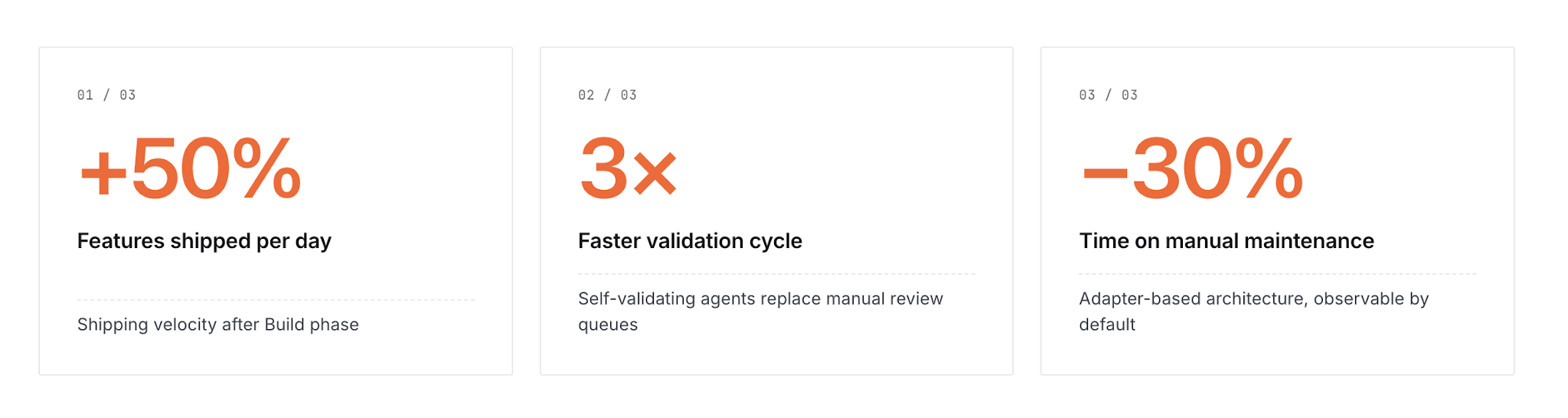
Teams use Atlas to target outcomes like +50% features shipped per day, 3x faster validation cycles, and -30% time on manual maintenance, depending on workflow maturity and adoption. The payoff is directional, not a guaranteed benchmark.
Weigh it against other layers in the AI Governance Tools Comparison.
AI governance compliance checklist for SOC 2 and HIPAA
A useful data governance checklist assigns each control to an owner and names the evidence produced during normal work. If a control depends on a manual memory prompt, it will weaken as AI adoption expands.
Use the checklist below during a pilot, architecture review, or internal audit to test your AI governance practices. Add your AI governance policies and legal, contractual, and customer-specific requirements before approving production use.
Adoption should expand only after your team can explain access, data, change, approval, and evidence for each workflow.
Control, evidence, and owner checklist
For HIPAA-related workflows, HHS describes access control, audit controls, integrity, authentication, and transmission security as technical safeguard areas in its HIPAA Security Rule summary, last reviewed March 19, 2026. Use those areas to map evidence, then have your privacy and compliance owners validate the mapping.
For SOC 2, connect controls to the applicable AICPA Trust Services Criteria rather than labeling every engineering practice as a separate requirement. The AICPA criteria resource is dated September 30, 2023.
Questions to answer before expanding AI adoption
See where your team sits before you expand in the AI Governance Maturity Model: From Vibe-Coding to Governed Velocity.
Before granting an agent broader access, ask:
- Can you identify the human owner and agent identity for every task?
- Can the agent access secrets, protected health information, or production systems?
- Which tools can it call, and which actions require approval?
- Does each change run in an isolated branch or workspace?
- Which tests and scanners block merge?
- Can a reviewer see the context, diff, findings, and approvals?
- Can an auditor reconstruct the path from task to deployment?
- How do you revoke access when an agent, credential, or model provider changes?
- Who owns AI oversight, exceptions, retention, incident response, and periodic access review?
The HIPAA breach notification page from HHS states that breaches affecting 500 or more individuals must be reported without unreasonable delay and no later than 60 calendar days.
That is why incident evidence matters before an incident occurs. Your team needs enough records to determine scope, affected data, access path, containment steps, and notification decisions.
Summary: Where to start with AI governance compliance?
AI compliance for AI-generated code depends on controls around the full development path: identity, permissions, data boundaries, isolated changes, human approval, and reconstructable evidence.
SOC 2 and HIPAA concerns become manageable when those controls produce records during ordinary engineering work. Together, these controls turn responsible AI governance into continuous monitoring and human oversight rather than a policy document.
Start with a focused workflow, map its access and data boundaries, then test whether your evidence answers an auditor’s questions without relying on individual memory.
Integrate AI governance processes into the pipeline as part of your AI strategy, not as a step you bolt on after deploying AI.
For a deeper review of your current engineering controls, talk to Blazity.
FAQ on AI governance compliance
Does AI-generated code need a separate SOC 2 control?
AI-generated code usually fits within existing controls for access, change management, security, and monitoring. Your workflow may need additional evidence showing which agent acted, what context it received, which checks ran, and who approved the change.
Can HIPAA-covered teams use AI coding agents?
HIPAA-covered teams can use AI coding agents only within a workflow that protects regulated data and controls access. Keep protected health information outside prompts, logs, fixtures, and generated artifacts unless your approved architecture and agreements permit that handling.
Is a pull request enough for an AI audit trail?
A pull request is useful but incomplete evidence for an AI coding workflow. It should connect to the task, agent identity, model or execution record, context, tool calls, automated checks, reviewer decision, and deployment outcome.
Should every AI agent have its own identity?
Each agent or agent class should have an attributable identity with scoped permissions and an owner. Shared human credentials make access review and incident investigation harder because the recorded principal may not match the actor.
Sources
- Summary of the HIPAA Security Rule, HHS.gov (last reviewed March 19, 2026)
- HIPAA Security Rule Breach Notification, HHS.gov
- 2017 Trust Services Criteria with Revised Points of Focus – 2022, AICPA & CIMA (September 30, 2023)
- AI Act, European Commission (July 7, 2026)
- 2025 GenAI Code Security Report, Veracode (2025)
- Cost of a Data Breach Report 2025, IBM (2025)
- AI principles, OECD
%201.svg)