
AI governance tools fall into four layers: frameworks, compliance platforms, observability, and engineering governance solutions. The one you need depends on where your risk actually shows up.
You reach for a different tool when you are proving regulatory compliance than when you are stopping a bad model output before a user sees it.
This guide defines each layer, provides questions that point you to the right one, and puts all options in a single comparison table. The goal is a stack that catches risk where it materializes, not a pile of dashboards that report it after the fact.
Key insights
- Only 4% of enterprises govern the AI they scale.
- Frameworks (EU AI Act, NIST AI RMF, ISO 42001) tell you what to govern. They do not do the governing. Tools split into GRC platforms, observability, and engineering governance solutions.
- No single tool covers every layer. Atlas governs the engineering layer that GRC platforms and monitoring tools leave exposed.
What is AI governance and why does it matter in 2026?
AI governance is the set of structures, policies, and controls that define which AI you have, what risks it poses, and whether it is operating within the boundaries you set.
It has moved from committee slide ware to board-level liability because two forces are now colliding: regulation with teeth and adoption that has outrun oversight.
According to Credo AI's 2026 State of AI Governance report, 60% of enterprises are scaling AI while only 4% are governing it.
To see what that exposure looks like once AI is live, check Top 4 AI Governance Challenges in Production.
That gap is real exposure: fines, reputational damage, and model-level incidents no retrospective report can undo. The organizations most at risk are the ones treating governance as documentation while the AI ships ungoverned.
For the full discipline behind these layers, see AI Governance Solutions: The Complete Guide to Governed AI Engineering (2026).
EU AI Act enforcement is live & NIST AI RMF adoption is accelerating
The EU AI Act entered into force on 1 August 2024, and its risk-based obligations are rolling out in stages.
Most of the high-risk rules under Annex III start applying on 2 August 2026. Penalties for prohibited practices reach €35 million or 7% of total worldwide annual turnover.
Treat the timeline as a moving target: the Commission's Digital Omnibus proposal may shift parts of the high-risk regime, so plan against both the current and the revised dates.
In the US, the NIST AI Risk Management Framework is voluntary. Its four functions – Govern, Map, Measure, Manage – have become the operational template teams adopt even without a mandate.
Which AI governance tool do you need? Decision framework for CTOs
Before you shortlist anything, work out which layer your problem lives in.
Answer these three questions in order:
- What regulation or standard does my AI fall under? This tells you which framework sets the bar.
- Who needs the evidence – a compliance officer, an auditor, or the engineering team that deploys the model? This tells you whether you need a GRC platform or engineering controls.
- Where does the risk materialize – in the AI inventory, in the model's behavior, or in how the system is built and shipped? This tells you whether you need observability, enforcement, or both.
If your risk sits in how AI-assisted code is built and shipped, start by governing what agents read: see Agentic Context Engineering: How to Govern the Knowledge Your AI Agents Read.
If your risk lives in how you build and ship with AI, no compliance platform will govern it – that is a different layer entirely.
Most enterprises start with a GRC (Governance, Risk, Compliance) platform and assume the job is done. It is not. The work is split across four layers that stay disconnected in most stacks.
Each layer answers a different question and passes its blind spot to the next.
- Frameworks set the rules. The EU AI Act, NIST AI RMF, and ISO/IEC 42001 define what you must govern, but they run nothing.
- GRC platforms manage the evidence. Credo AI, OneTrust, Holistic AI, and IBM watsonx hold the AI inventory, risk scores, and compliance reporting an auditor asks for.
- Observability tools trace runtime behavior. Langfuse and Arize capture traces and run evals across your AI apps, but only after a request has run.
- Engineering governance solutions govern the development layer. Atlas owns repo-based context, agent rules, review artifacts, and workflow controls, and records how AI-assisted work happened.
The first three layers describe and observe governance; only the fourth enforces it in the request path.
AI tools comparison table: platforms, frameworks, and solutions
Here is the full field in one view.
Frameworks set the rules, GRC platforms manage the evidence, observability tools watch behavior, and engineering governance solutions enforce policy at the moment a model acts.
Read (and scroll) the table, then use the sections below for the details on each option.
No row wins on every column, and that is the point: these tools govern different things, so most enterprises run more than one.
Engineering governance solutions
Engineering governance solutions govern the development layer: how AI-assisted code gets written and shipped. This is the layer GRC platforms and observability tools leave open, and it is where AI adoption grows fastest as coding agents write more production code.
Atlas is Blazity's solution for shipping production software as a governed system. It keeps context in the repo, sets the rules coding agents must follow, and produces review artifacts for every AI-assisted change. It records how the work actually happened: which context was used, which rules were applied, and what the agent did.
This matters because the fastest-growing source of ungoverned AI is engineers shipping AI-assisted code with no record of how it was produced, no repo-owned rules, and no evidence an auditor can read.
See how to make that code SOC 2- and HIPAA-ready in AI Governance Compliance: How to Keep AI-Generated Code Secure and Compliant (SOC 2, HIPAA).
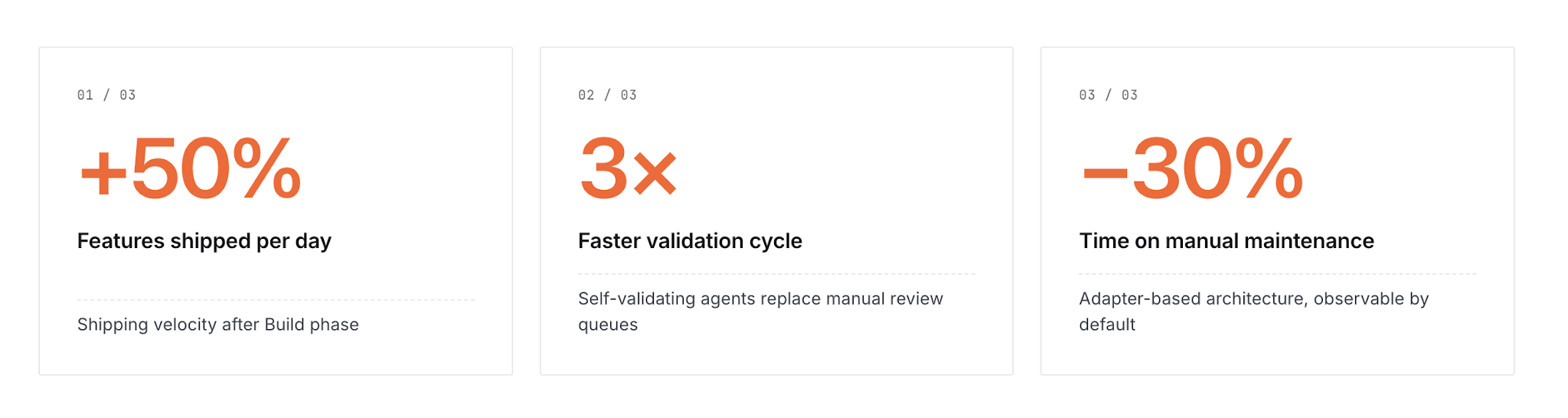
Teams use Atlas to target outcomes like +50% features shipped per day, 3x faster validation cycles, and -30% time on manual maintenance, depending on workflow maturity and adoption. The payoff is directional, not a guaranteed benchmark.
Atlas is built to govern the engineering process you already run, not to replace it, which is what "autonomous, but governed" means in practice. See the GitHub repo.
Frameworks
Frameworks are the spec. They tell you what policies, risk assessments, and audit trails you must produce, but they do not produce or enforce anything.
- The EU AI Act defines four risk categories – unacceptable, high, limited, minimal – plus conformity assessments for high-risk AI systems.
- NIST AI RMF adds a four-function risk management process.
- ISO 42001 adds an auditable management system structure.
All three are documentation-heavy. A framework gives you something to point an auditor at; it leaves the registries, testing, monitoring, and human-override gates for you to build.
GRC (Governance, Risk, Compliance) platforms
GRC platforms are the organizational layer. They give compliance and risk teams a central place to inventory models, score risk, manage policy, and produce audit-ready reporting across departments and jurisdictions.
Credo AI is purpose-built for AI governance, with an AI registry, policy engine, and compliance and risk management.
OneTrust AI Governance extends a broad privacy-governance engine into AI inventory, risk assessment, policy enforcement, and framework mapping.
Holistic AI splits its work into three pillars – Identify (shadow AI discovery and inventory), Protect (bias and security testing, red teaming), and Enforce (compliance workflows and audit evidence).
IBM watsonx.governance adds model inventory, risk, and lifecycle governance for teams already standardized on the IBM stack.
Each of these platforms collects the evidence an auditor wants to see. None of them sits in the critical path of a model request and decides whether it proceeds – they manage risk, they do not stop it.
Observability and monitoring
Observability answers a different question: "what is the AI model doing right now?"
Langfuse and Arize capture request traces, run evals, and surface anomalies across any AI app through continuous monitoring. That gives you real-time visibility into model and agent behavior once it is deployed.
Observability tells you a hallucination shipped; without a gate in the request path, it cannot stop the next one.
To learn how to keep autonomous agents auditable at runtime, see AI Agent Observability: How to Make Autonomous Agents Auditable.
Summary: How to choose the right AI governance tool?
The right AI governance tool is the one that closes the gap between a signed policy and a shipped model.
- If you need to prove compliance to a regulator, start with a GRC platform.
- If you need to see what your models are doing, add observability.
- If you need to stop what your models do before it reaches a user, bring governance into the engineering layer – then connect the layers so a policy change becomes an enforced gate.
Pick the pieces that match the risk you actually carry, and make sure at least one of them lives in the request path.
Talk to Blazity or explore Atlas to see which AI governance solution fits your stack.
FAQ on AI governance software
What are the best tools for governing AI models?
The best tool depends on which layer of model risk you are governing.
- For runtime control over model behavior, Atlas owns repo context, agent rules, and review artifacts on the development layer.
- For organizational model risk management, GRC platforms like Credo AI, OneTrust, Holistic AI, and IBM watsonx handle registries, risk scoring, and compliance reporting.
- For runtime behavior, observability tools like Langfuse and Arize trace requests and run evals.
What are the 5 main AI tools?
In AI governance, tools cluster into five types rather than five fixed products.
These are frameworks (EU AI Act, NIST AI RMF), GRC platforms (Credo AI, OneTrust, IBM watsonx), AI observability (Langfuse, Arize), data classification and access control, and engineering governance solutions (Atlas).
Each covers a different part of the AI lifecycle, from defining obligations to enforcing them at runtime. Naming the type you need is more useful than chasing a single best product.
What is the difference between AI governance frameworks and AI governance tools?
Frameworks define what you must govern; tools operationalize it. The EU AI Act, NIST AI RMF, and ISO 42001 set risk categories, documentation, and management processes. Tools are the software that runs them: registries, policy engines, monitoring, and enforcement.
What is the best AI governance tool for engineering teams?
It depends on where the risk hits. If the risk is in how AI coding agents build and ship your software, Atlas governs that development layer with repo-owned context, agent rules, and audit-ready review artifacts. If the risk is organizational compliance, a GRC platform is the starting point.
%201.svg)